
Insight 6-4 | November 25, 2025 | Ian Garner
The Duty to Destroy: Russian Identity Formation and Human (In)Security in Mariupol
Ian Garner is an Assistant Professor at the Pilecki Institute, Warsaw. He received his PhD from the Slavic Department at the University of Toronto (Canada) in 2017, where he wrote his doctoral thesis on the myth of the Battle of Stalingrad. The author of two scholarly books, his research interests primarily lie in Russian and Soviet military culture and propaganda. He regularly comments and writes for major media outlets across the world. In 2024, Dr. Garner was made a Fellow of the Royal Historical Society, London.
Time to Read: 22 minutes
Home / Publications / Insights / Insight 6-4
*This article also appears as a chapter in the 2024 KCIS Conference volume that was published in Sept. 2025
According to the Kremlin and its propagandists, Russia’s full-scale invasion of Ukraine was launched in defence of civilians. State actors claim that Russian forces are variously protecting the “language rights”—which are claimed to be under threat due to the downgrading of Russian versus Ukrainian within the country since the Maidan Revolution in 2013—and the security of “ethnic Russians,” a term the Kremlin uses to claim moral ownership of and legal obligation toward Russian-speaking minorities across formerly Soviet territories. Indeed, the regime has, since 2014, when it began the war against Ukraine with the invasion of Crimea, Luhansk, and Donetsk, purported to be preventing a “genocide” being waged against these “ethnic Russians” by Kyiv. Propaganda channels are filled with lurid and apocryphal stories of violence committed by Ukrainian forces against ordinary people.[1] The Russian state thus asserts its duty to prevent these crimes. As Vladimir Putin claimed in the speech televised on February 24, 2022, Russia “had to stop [Ukraine’s] genocide” in Donbas.[2] Sergey Lavrov, the country’s foreign minister, made the purpose of Russia’s war clear in an address to the UN Human Rights Council several days later: “The goal of our actions is to save people by fulfilling our allied obligations, as well as to demilitarize and denazify Ukraine so that such things never happen again.”[3] Moscow frames its justification for war as a necessary and legal intervention—a moral “obligation”—to ensure the safety and security of citizens.
Scholars such as Alexander Etkind and Kseniya Oksamytna situate this language within discourses on Russian colonialism, arguing that the war is an act of ethno-nationalist supremacism.[4] In this reading, Russia has in its tsarist, Soviet, and post-Soviet iterations been a settler-colonial state that has sought to claim ownership, through imperial and often violent control, over a swath of the Eurasian space. In this reading, a “Great Russia” (or the near synonymous near abroad and russkii mir, or Russian world) expands beyond the legal bounds of the Russian Federation and to the maximal limits of the historical Muscovite empire. Here, Moscow foregrounds narratives of ethnic Russians as a more civilized and enlightened population with the historical and spiritual mission to guard and protect the neighbouring, or colonized, populations. Such imperialism is enduringly popular among a large part of the Russian population today.[5]
Despite these claims, the Russian war against Ukraine has shown little regard for human security. The Russian armed forces’ conduct both during and after fighting has been characterized by mass violations of International Humanitarian Law and human rights: civilian targets have been deliberately attacked, civilian infrastructure has been destroyed en masse, and evidence of war crimes has emerged—including sexual violence, arbitrary executions, murder of enemy combatants and civilians, and the deportations and abductions of children for which the International Criminal Court (ICC) has indicted Vladimir Putin. In just under a year of fighting, the United Nations reported over 18,000 civilian casualties (UN), which is likely an underestimate. The population in occupied regions has fallen, according to Ukrainian authorities, from almost 6.5m to 3.5m. Residents—approximately 200,000 in the six months leading up to February 2025—continue to depart the occupied territories in the east of Ukraine.[6] In addition, a cultural war against Ukrainianness has been waged: authorities use violent tactics to enforce Russification through re-education, passportization, and re-culturalization policies.[7] Russia’s policies are, some scholars allege, tantamount to genocide.[8] While this term is not litigated here, it nevertheless underscores the severity of Russia’s behaviour in occupied Ukraine.
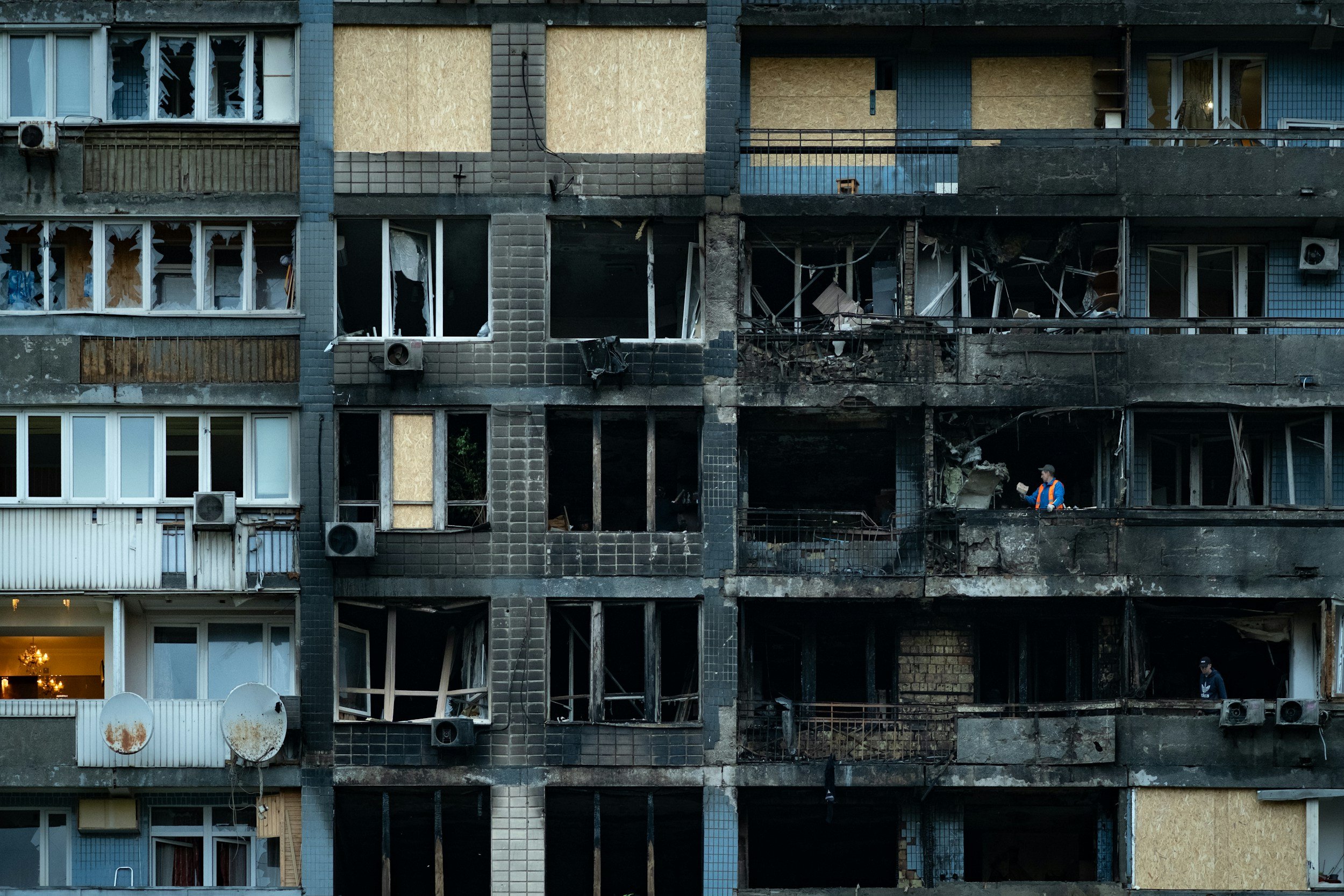
The most severe example of destruction in the first phase of the war was the obliteration of the Ukrainian city of Mariupol, located close to the border of the regions invaded and occupied in 2014. In the first weeks of the war, Russian forces besieged, assaulted, and then occupied the city. During this combat phase, seven hospitals, one hundred and thirty educational institutions, and over 60,000 homes were destroyed. Russian forces deliberately targeted civilians, claiming that the Ukrainian Army was using them as a human shield. As a result of this violence, somewhere between 20,000 and 80,000 civilians perished.[9] Mariupol was all but completely destroyed, and its pre-war population through death and displacement decimated. Since cementing control of the city, the Russian occupying regime has implemented familiar Russification strategies and policies of deportation, torture, and extrajudicial killing.[10]
Despite the state’s claims to be protecting “ethnic Russians” in the east of Ukraine from a genocide conducted by their own, legal government, neither Russian state actors nor propagandists have attempted to hide the extent of the violence directed at Ukraine and, in particular, Mariupol. Speaking to Ministry of Defence employees in December 2022, Vladimir Putin—in comments published on the Kremlin website and widely distributed by state media channels—declared that “[t]he important industrial centre of Mariupol was completely cleansed of Nazis by the end of May. The Kiev [sic] regime had turned the city into a strongly defended locale whose centre was located in the Azovstal factory. As a result of the Russian Armed Forces’ and the Donetsk People’s Militia’s successful actions, more than 4000 fighters were destroyed and 2500 Azov nationalists and SBU [Ukraine army] servicemen laid down their arms and surrendered.”[11] State-approved and state-run media—including TV news, newspapers, and the web of Telegram, VK, and other digital channels, often run by grassroots groups and amateur bloggers and are the most popular news sources for most Russians—openly covered the wave of destruction in Mariupol.[12]
A dissonance thus emerges between the state’s public rationale for war, its humanitarian mission, and its conduct of that war. Nonetheless, as with other news of Russian crimes in occupied Ukraine and despite the accessibility of non-state-controlled discussion channels online, such as Telegram, a broad section of the public did not protest against this apparent dissonance. Instead, a familiar refrain emerged: killing “ethnic Russians” could mean saving ethnic Russians.[13] This problematic becomes even more puzzling when considering the apparent lack of public or state interest in responding to or preventing the numerous attacks Ukraine has made against Russia’s own territory, which have included drone attacks on Moscow—including against the Kremlin itself in May 2023—repeated missile strikes on the Bryansk and Belgorod regions and on occupied Crimea, and even the occupation of Kursk in August (which continues at the time of writing in late 2024). In rational terms, Russia has failed to “save” Ukraine or Ukrainians. Thousands of its own soldiers are dead, its economy is in tatters, and it is more isolated internationally than at any point since the early Bolshevik years.
Context and Method: Identity, Reinvention, and Patriotic Duty
This paper explores the contradictions around the Russian state’s attacks on Ukraine, exploring state and popular discourses of the city of Mariupol’s fate—its resettlement and regeneration—in the almost three years since its occupation. The work builds in particular on “post-secular” conceptions of human security, which aim to interrogate the possibilities for conducting liberal internationalist policies aimed at ensuring human security in a culturally fragmented and contested world.[14] Both post-Soviet Russian governments have sought to engage with the rhetoric of human security and related ideas such as the responsibility to protect, deploying these conceptions to justify its military interventions to international audiences.[15] The Putin regime in the 2000s struggled to do the same domestically, despite extensive control of the media, when fighting Chechnya. Domestic audiences, shocked at the death toll and misconduct at the front, were highly critical of the regime’s ongoing war as one to ensure the local population’s safety.[16] However, Russian political and academic actors have in recent years sought to reimagine the idea of “human security” as embracing post-secular notions including “spiritual security,” which includes protecting “traditional” Russian values—nationality, Orthodoxy, and language—in the post-Soviet space.[17] Indeed, this notion is now enshrined in the state’s national security and foreign policy concepts.
This conception of human security has to be understood within the state’s efforts to construct a new patriotic identity for its citizens since the “patriotic shift” in 2012. When Vladimir Putin returned to the presidency, he instituted a domestic crackdown against Western values and a hardline, Russia-first foreign policy, an approach that the state at first struggled to accompany with “internal transformational tasks.”[18] Since then, however, the state has slowly developed a stable and cohesive ideological repertoire built around the citizen’s patriotic duty to reinvent the self as a militarized Orthodox Christian who upholds “traditional values” (chiefly masculinity, heterosexuality, and patriarchy).[19] Deploying a wave of propagandizing materials that spans the classroom, places of employment, and traditional and digital media, the regime disseminates narratives that encourage Russians to participate in its projects to transform the country from a democratic post-Soviet state into a re-Sovietized and authoritarian bastion of “traditional values.” These phenomena are clearly on display in the state’s treatment of Mariupol, and the interactions of ordinary Russians with the discourses the state has produced about the city since 2022.
The conduct of a brief Critical Discourse Analysis of state claims and state and public social media postings linked to the post-occupation regeneration of Mariupol illustrates how this functions in practice. Fairclough's model of CDA provides a comprehensive approach to showing the links between discursive practices of production and interpretation and the broader sociopolitical contexts that shape discourse; that is, the links between the discourses of the state and the broader public as the former shapes the latter and vice versa.[20] This methodology allows for a nuanced analysis of how linguistic choices, rhetorical strategies, and intertextual references in and on online comments and videos construct and legitimize Russian narratives of destruction and regeneration, subtly (re)creating state power. What follows represents an application of this methodology to a review of materials published between February 24, 2022 and November 1, 2024: minutes of meetings and speeches that mention Mariupol and which are published on the Kremlin website; newspaper reports available online and indexed through Yandex News; and a selection of viral social media posts and comments scraped from those posts that discuss both of the above (n=4,802).
Employment of a systematic approach that examines lexical selection, argumentative structures, and implicit ideological meanings within these texts uncovers the discursive mechanisms through which state-approved collective identity around violence is normalized. Discursive strategies, in particular on social media, allow the construction of post-truth—apparently contradictory—realities in Russia.[21] As a result, social actors can transform destructive acts into a coherent narrative of collective meaning-making and self-reconstruction on immersive platforms that allow complete engagement with artificially created realities.[22] This reveals that the destructive war to “save” Ukraine is, in fact, an ethno-nationalist and colonial project that, when experienced digitally, allows the state to claim that it is rebuilding Mariupol even as it has destroyed, and continues to destroy, the city and its inhabitants. In turn, Russians are presented with the opportunity to imitate the state and respond to the “duty” to reinvent themselves—while the state simultaneously rebuilds Mariupol—as patriotic subjects. This analysis reveals the challenges scholars and practitioners interested in human security will face when attempting to counter Russian aggression both today, as they consider what a peace deal in Ukraine might look like, and tomorrow, as the Russian state shows no sign of lessening the belligerence at the heart of its national security strategy and takes advantage of digital communications tools to shape identities at home.
The Ideology of the Future: Rebuilding Mariupol
After the occupation of Mariupol, and at Putin’s behest, an official “master plan” for the reconstruction of the city was created. Released in 2022 to public fanfare, the document resembles a classical settler-colonial plan to build a new and desirable space for settlers from the metropole. By 2035, the Russian Federation will purportedly spend over $800 million (USD) on constructing 18 million square metres of housing, revitalizing key industries, building transport infrastructure within the city and to link it to mainland Russia, restoring and expanding green areas, and expanding the population from 212,000 to 500,000 by attracting Ukrainian residents and Russian settlers. Since then, new announcements have kept coming. Most recently, Deputy Prime Minister Marat Khusnullin announced that, by thinking 20 years ahead, another plan would “create the ideology of the future” within Mariupol.[23] The Russian state, therefore, continually emphasizes that this is not merely a plan to create a livable city but to create an ideal city, a new sort of city for an ideologized nation—one of the future.
Nonetheless, official discussions of these plans are in fact redolent with discourses of nostalgia and duty, which thus emulate the state’s own justification for war as an “obligation” to intervene. Nostalgia runs deep through the public meetings and discussions made available on the Kremlin’s website. In a discussion about the construction of Mariupol’s streetcar, for instance, Saint Petersburg Governor Aleksandr Beglov and head of the Donetsk People’s Republic Denis Pushilin linked the reconstruction of Mariupol to the World War II Leningrad Blockade—a central part of the state’s memory politics that is used to celebrate Russians’ dutiful resilience during hardship and successful post-war reconstruction (Kirschenbaum 2009)—and to the 1933 construction of a Stalinist streetcar system in Mariupol, respectively.[24] In a meeting between Putin and leaders from the occupied regions held at the state-run Museum of Victory, Russian parliamentarian and journalist Aleksandr Mal’kevich linked the rebuilding effort with the post-war reconstruction effort, equating it with a “battle on the information front.[25]” Rebuilding the city is, he claimed, “our moral duty”—the italicized phrase was often used as a Soviet exhortation to encourage efforts to produce, participate in society, and recreate the self (DeGeorge 1969). It is through reconstruction that citizens will create the “Russian Spring,” a euphemism for the rebirth of “Great Russia.”[26]
When mayors and politicians discuss using construction to bring Mariupol into “great Russia” (Morgun), into the “modern” world,[27] or into a transport network that seamlessly links the Russian Federation and its newly claimed territories,[28] they are not simply referring to a literal recreation or modernization of the city. The discursive focus of nostalgia and duty is turned away from saving Ukraine in these discourses and toward creating a simulated, imagined site of Russianness—a combination of Soviet nostalgia and future-oriented imperialism—that allows Russia to (re)imagine itself in new, greater, extended forms in line with Etkind’s and Oksamytna’s thinking on the country as a colonial entity.
This turn is reflected in official media coverage of the city’s reconstruction. In dozens of articles showcasing the building work since 2022, images and words emphasize the former destruction and future liveliness of the city, which is presented as being emblematic of a new Russianness: “Ukraine couldn’t manage this much in thirty years,” as one RIA Novosti headline put it.[29] That new Russianness will “go into the history books,” as if nostalgia for the past is being replaced by the return of that past.[30] In each article, the scale of the Russian army’s destruction of the city, if not mentioned in text, is presented through contrapuntal images showing the bombed city and its new version.[31] Media operatives inflate the state’s rhetoric to ever more grandiose levels, asserting that over 2 million people will live in Mariupol within five years.[32] Discursively, the reconstruction of the city is linked more deeply to remaking Russia than Ukraine—a phenomenon only made possible by the (repeatedly foregrounded) destruction of the old.
When intertwined around notions of Mariupol as an ideal, or “all-Russian,” site, these discourses in turn link the reconstruction of place, or Russia, to the reconstruction of the self, or the Russian. A series of heavily promoted incentives use consumerist discourses to project the image of building a new and attractive life in Mariupol. Journalists emphasize the availability of spacious new apartments that offer a “peaceful life.”[33] Websites for new real estate projects are plastered with reminders that the state offers a limited-time 2% mortgage rate for purchases in the city—an enviable offer when interest rates elsewhere are now close to 30%.[34] Slick Instagram videos tour new housing developments, their narrators—typically young and glamorous influencers—wondering at the low prices and high salaries and availability of goods in the city.[35] Against an upbeat soundtrack, one presenter declares that, “You’ll be amazed at these houses!”[36] Any Russian viewer watching these videos go viral, as many have done, can indulge in the same vicarious immersion that sees internet users reimagine themselves through engaging with such consumerist discourses.[37]
In reality the reconstruction and settlement of Mariupol has not lived up to the state’s grand promises. While the state planned to reach a population of 350,000 by 2025, the evidence suggests that this target will be missed.[38] The media obfuscates and hides real settlement figures: among the various numbers floated in recent months, 40,000, 70,000, and 150,000 Ukrainians have returned, while the numbers of Russians arriving is simply left undocumented.[39] According to Ukrainian sources, approximately 80,000 individual have arrived from mainland Russia, although the majority of these are temporary residents working on construction projects.[40] Indeed, while satellite evidence reveals that some residential construction has taken place, in reality local residents still struggle to find housing and continue to suffer from repression, including the seizure of housing by the occupying army. The new builds are generally of poor quality, and there is little interest in real estate purchases from Russians.[41]
The clash between vision and reality are manifold. For example, while 2% mortgages are advertised widely, they are almost exclusively for the few new builds made available, and the scheme will end in 2030.[42] Indeed, while state media trumpeted the story of the first resident to take out one of these bargain mortgages, the detail suggested that his situation was hardly typical: borrowing $47,000 (USD), to be repaid in full within five years, with a $7500 down payment that is hardly feasible for most Russians. Moreover, the mortgage was for an unfinished apartment that may never be completed: in effect, and if the story is true, it is as likely that the citizen was loaning hard currency to the state as it was that he was purchasing a new life in Mariupol.[43] The issue is repeated across the real estate market in the city. On the websites and social media platforms where property trading is common, few users are joining groups dedicated to property in Mariupol. One of the largest groups on the popular platform VK, Nedvizhimost’ Mariupolia, had just over 5,000 members in November 2024. Over the past month, an average of under ten users had viewed each advert on the group. The issue is not helped by high prices in the city, where the cheapest available apartment, an unrenovated studio in a partially destroyed city block, is currently on sale for 2.2 million RUB ($20,800 USD), a price of 66,000 RUB per square metre[44]—while the next cheapest was twice the price. Claims that new builds will sell for as little as 70,000 RUB per square metre can hardly seem realistic to buyers. Despite the narratives of rebuilding Mariupol as a means to emulate what are promoted as impressive achievements of the past, and thus create a utopian city of the future, reality falls far short.
Dutifully Rebuilding the Self
Despite the gap between vision and reality when it comes to the reconstruction of Mariupol, the state has done little to change course. Aside from a slight easing of restrictions around the cheap mortgage plan and the continued funnelling of money into construction, little is being done to bring Russian settlers into—let alone to draw Ukrainians back to—Mariupol. Instead, the state’s reconstruction plan continues to function chiefly on the discursive and symbolic levels. The intention appears to be to encourage a symbolic mobilization of the public to reinvent the self around the notion of reconstruction. In May 2024, Putin explained at a meeting of the Council for Strategic Development and National Projects—which is deeply involved with work on Mariupol—that repairs, rebuilding, and construction across Russian territory, including the occupied regions, carried great historical importance: “Everyone should understand the times we are living in and the historical stage Russia is going through…everyone should work as if on the front line, everyone should feel mobilized, and only in this way will we achieve the goals that we set for ourselves.”[45] Putin’s words imply that construction is in and of itself part of the country’s broader militarization:[46] to understand, to engage with, and to work in and on a broader, symbolic reconstruction is to participate in the transformation of today’s Russian Federation into tomorrow’s “Great Russia.”
The state and its supporters have thus set forth in the media a series of stories about model individuals who have not settled in physically colonized Mariupol but have engaged with the narrative of the city’s destruction and reconstruction in order to recreate themselves. On each occasion, these stories have reiterated the same discourses of nostalgia and duty discussed above, linking the reconstruction of the individual or the self to the reconstruction of the city. Moreover, on each occasion, destruction of the individual has been the precursor to new life.
Marianna Vyshemirskaya is a Mariupol native who was wounded during a Russian attack on the city’s maternity hospital in March 2022. Photographed, bloodied and wrapped in a blanket, in the rubble of the hospital, Vyshemirskaya went viral on Ukraine and Western networks as a symbol of Russian violence.[47] Russian authorities rapidly used their media platforms to attack the photographs as fake, and made death threats toward Vyshemirskaya. Nevertheless, by 2024, Vyshemirskaya had become a symbol of Russified Ukraine in Russian propaganda organs. Now living in Moscow, she collaborates with an astroturfed, pro-Kremlin NGO, Rodina (“Motherland”), which promotes the regime’s “traditional” family values. Media has covered Vyshemirskaya’s enthusiastic embrace of Putinism, depicting her voting for “Team Putin” during the 2024 presidential election: “Despite all the sanctions and problems, Russia is developing with dynamism” explained the 32-year-old, parroting almost verbatim the state’s discourse of the future. Vyshemirskaya now participates in the state’s history projects, for example activities around the 9 May (Victory Day) holiday, linking these activities to the fate of Mariupol.[48] In response, the state’s media operatives hail her as a “strong woman” with roots in the USSR.[49]
Vyshemirskaya may have had little choice about her public activities given the increasingly authoritarian politics of the Russian state, but her transformation into a dutiful Russian patriot with deep roots in the nostalgic past serves as inspiration for her thousands of followers on Telegram, which she uses to post lifestyle updates, patriotic comments, religious messages, and state propaganda in the “discourse laundering” style the Kremlin increasingly favours.[50] Followers, both real or fake, respond to her posts, in particular those about the destruction or subsequent fate of Mariupol, with a combination of nostalgia, hatred, and transformative zeal: “Many Ukrainians didn’t even want to be in Ukraine after the USSR!”; “There can be no justification for the Ukrofascists, they all have to answer for their actions”; “You’re an example of the resilience and honesty of Russia’s young women!…I hope to realize your good start.”[51] In this trio of comments, we trace out the discursive arc of Mariupol: a nostalgic longing for a greater Russian, imperial (Soviet) past; the call for destruction; and the desire to imitate the subsequent transformation into a better sort of Russian. The act of “colonizing” Mariupol is carried out discursively: pro-Kremlin Russians, in isolated social media groups where dissenting voices are absent and bots and trolls amplify sentiments, are able to engage in or witness an enthusiastic transformation of Russian selves thanks to the destruction of Ukraine.
The case of Nastya Ivleeva, a 33-year-old celebrity influencer and television host, follows the same trajectory. Ivleeva, an ethnic Russian, was publicly disgraced by state media after hosting a purportedly debauched party to celebrate the New Year at the end of 2024. Several days of intense criticism saw Ivleeva condemned as treasonous for hosting the party during the “Special Military Operation.” The affair culminated in a veiled public attack by Putin himself, who criticized Russians who choose “different values.”[52] Ivleeva issued a series of public apologies, including an hour-long confessional interview on the popular Luka Yebkov YouTube channel.[53]
In the interview, Ivleeva recounts her life story, tearfully explaining her difficult past and mistakes she had made in childhood, inverting the discourse of nostalgia to imply that her “different values” emerge from close encounters with Westernized celebrity culture in the past. Mariupol serves, however, as a means to symbolically cleanse herself both of this distant past and of her more recent transgression. Ivleeva announces that she decided to travel to the “half-ruined city” of Mariupol, which “cannot leave you indifferent.” She explains that the city is still at war: “you can hear the war, it doesn’t cease...you don’t need to go far to the line of contact to hear the sound of artillery shells.” Nevertheless, she explains, “it’s a unique sight, how a new life is being born from among the ruins…a life of freedom and free choice is being created.” In the interview, therefore, Ivleeva washes away the sins of her old Westernized celebrity life by discussing her dutiful trip to a city where life is being recreated. The public “destruction” of Ivleeva is followed by her own “regeneration” thanks to her encounter with Mariupol and, as in the case of Vyshemirskaya’s followers, commenters reiterated the language of duty and future, praising Ivleeva as a manifestation of “holy Rus’” (a historically and symbolically charged word for medieval and Orthodox Russia) after “finding the internal strength” to transform herself. Whether Ukrainian, like Vyshemirskaya, or Russian, like Ivleeva, the individual is able to reiterate state propaganda discourses of the past and patriotic duty as they pertain to Mariupol in order to “transform” themselves into better Russians: indeed, in a corpus of 4,802 user comments scraped from the above posts, the most frequently occurring words were “now,” “time,” “future,” “necessary,” and “Russia.”[54] Destruction is thus constantly reiterated as socially desirable; actually rebuilding or settling in Mariupol is less important than performing the colonization of the city.
Conclusion
The destruction of Mariupol is in these instances of political, media, and popular discourse, ever-present, even within discussion of reconstruction and regeneration. Discursively, this destruction appears, as many of the comments studied may not come from real users, to emanate from below as much as above.[55] There is no public attempt to hide or justify responsibility for the destruction of Mariupol. Instead, destruction becomes an integral part or an “obligation” of identity construction around conflict and its aftermath. In a country that is mired in narratives of loss of identity, self, and great power status since the collapse of the Soviet Union in 1991, the dissemination of language of Mariupol’s reconstruction and resettlement creates a simulacrum of reality—in the Baudrillardian sense—that overrides the real.[56] Ordinary Russians can, if they wish, choose to participate in this simulacrum and thus in their patriotic “duty” to reinvent themselves, like Vyshemirskaya and Ivleeva, along the lines of the state’s discourses. Virtually, they are transformed against the background of Mariupol’s (faked) attractive, consumerist lifestyle, where all the purported and real issues of mainland Russia, such as the loss of “traditional values,” infrastructural deficits, and housing shortcomings, are resolved in an imagined landscape. At no point is the state or are Russians required to actually rebuild or colonize Mariupol in order to buttress this phenomenon through encounters with empirical reality.
The development of approaches like human security is intended to break the link between war and the destruction of humans, helping to consolidate liberal peace and stability in conflicts across the globe. Yet today’s Russian Federation challenges these developments with its disregard for international law, agreements and treaties, the United Nations, and the fate of civilians in warfare. This is driven by Moscow’s post-secular and post-modern approach to international and domestic affairs on all levels.[57] The phenomenon is not new.[58] In an increasingly digital era, the collapse is taking on new forms in and around the depiction of the war against Ukraine as an ever-shifting, constantly recombinating digital landscape that offers myriad opportunities for participating in and reproducing violence. Moscow thus appears to be reviving the European authoritarianism of the 20th century, destroying and imbuing (re)constructed urban locations with vast utopian potential.[59] It showcases its army’s destructiveness in the media, as the Soviet and Nazi totalitarian states did during the Second World War in Die Deutsche Wochenschau and publications like Krasnaia Zvezda and Ogonyok. Nonetheless, the development of digital media allows Russian subjects, and “converts” like Vyshemirskaya, to engage directly in and around resettlement thanks to its immersive capacities.
Online, destruction can be constantly restated—or, in the case of an individual like Ivleeva, created ex nihilo and symbolically—so that users can receive and reiterate narratives of self-cleansing and self-recreation. The hyperbolic plans to reconstruct and settle Mariupol exist as imaginative repositories for the reconstruction of Russia and Russians:[60] in this virtual space, activating discourses creates a “Great Russia” that responds to the nostalgic potential and loss of the Soviet and tsarist eras. Yet in this reality, the dissonance between Russia’s plan to “save” Ukraine and its real destruction of Ukraine is rendered null, for the war is really waged to save Russia itself. Thus, the war becomes an act predicated on sweeping away the deleterious present embodied in Ukraine and other symbols of “non-traditional values,” whether they are located at home or abroad. In this world, destruction can be potentially limitless since destruction is a constant and constantly necessary discursive catalyst. The more the war is destructive, the more the nation is “mobilized” and rebuilds itself.
As the war against Ukraine continues into 2025, and despite the challenges of negotiating with Russia, politicians, analysts, and commentators are discussing the contours of a potential peace deal. The fate of Ukrainian citizens still residing in the occupied territories in the east of Ukraine remains a vital issue for Kyiv’s negotiators, even though it has been—at least publicly—neglected by both Moscow and Donald Trump’s White House.[61] UN General Assembly resolution 66/290 calls for “people-centred, comprehensive, context-specific and prevention-oriented responses that strengthen the protection and empowerment of all people.”[62] If human security is to be central to peace in Ukraine, negotiators, politicians, and military planners must understand the post-modern and post-secular “local realities” of how and why Russia’s destruction of Ukraine has been justified to the Russian public—and how that public can immerse themselves and vicariously participate in the reconstruction of Mariupol online as a means to improve their own social status. This means recognizing that Ukraine will be continually subject to attack, as numerous scholars have argued, no matter how much it may damage the Russian nation economically or physically.[63] Solutions to resolve the conflict must rest on addressing, disrupting, or breaking the systemic and symbolic links between war and an improved Russia and Russianness. That, in turn, rests on understanding that Russia’s war against Ukraine is rationalized in post-secular terms and chiefly in online communities—and that the war is as much about creating Russia as it is about destroying Ukraine.
End Notes:
[1] Taras Kuzio, “Ukrainian versus Pan-Russian Identities: The Roots of Russia’s Invasion of Ukraine,” Studies in Ethnicity and Nationalism, Vol. 24, No. 3 (2024).
[2] “Address by the President of the Russian Federation,” kremlin.ru, February 24, 2022. http://en.kremlin.ru/events/president/news/67843.
[3] "Russian Actions Aim to Save People, Demilitarize, Denazify Ukraine — Lavrov." TASS, March 1, 2022. https://tass.com/politics/1414061.
[4] Kseniya Oksamytna. "Russia’s Status as a Colonial Power." E-International Relations, November 1, 2024. https://www.e-ir.info/2024/11/01/russias-status-as-a-colonial-power/; Alexander Etkind, Internal Colonization: Russia’s Imperial Experience (London: Wiley, 2013).
[5] Kseniya Oksamytna, “Imperialism, Supremacy, and the Russian Invasion of Ukraine,” Contemporary Security Policy 44, no. 4 (2023): 497–512.
[6] “UNHCR: After three years of war, Ukrainians Need Peace and Aid.” UNHCR, February 18, 2025.
[7] Natalia Savelyeva, Yana Lysenko, Fabian Burkhardt, David Lewis, and Anna Veronika Wendland. "Russian Occupation in Ukraine." Ukrainian Analytical Digest 3 (November 2023). https://css.ethz.ch/publikationen/uad/details.html?id=/n/o/3/r/no_3_russian_occupation_in_ukraine.
[8] See e.g. Patrycja Grzebyk and Dominika Uczkiewicz, eds, The Russian-Ukrainian Conflict and War Crimes: Challenges for Documentation and International Prosecution (Taylor & Francis, 2024).
[9] Human Rights Watch. Counting the Dead. 2022. https://www.hrw.org/feature/russia-ukraine-war-mariupol/counting-the-dead.
[10] Nikolay Petrov, Russia in the Occupied Territories of Ukraine: Policies, Strategies and Their Implementation. SWP Comment 38/2024. Berlin: Stiftung Wissenschaft und Politik (SWP), Deutsches Institut für Internationale Politik und Sicherheit, 2024. https://doi.org/10.18449/2024C38.
[11] “Zasedanie kollegii Ministerstva oborony,” kremlin.ru, December 21, 2022. http://kremlin.ru/events/president/news/70159.
[12] N.O. Natalina, “Telegram Channels as Tools of Strategic Communication: A Study on Ukraine’s Media Landscape during the War,” Visnyk Donetskoho Natsionalnoho Universytetu imeni Vasylia Stusa, 2023, 53–60.
[13] Ian Garner, “‘We’ve Got to Kill Them’: Responses to Bucha on Russian Social Media Groups,” Journal of Genocide Research, May 9, 2022, 1–8.
[14] See e.g. Giorgio Shani, “Human Security as Ontological Security: A Post-Colonial Approach,” Postcolonial Studies 20, no. 3 (July 3, 2017): 275–93; and Giorgio Shani, Religion, Identity and Human Security (Routledge, 2014).
[15] Stephen Shulman, “Justifying Forceful Resistance to Ethnic Separatism: The Case of Russia versus Chechnya, 1994–96,” European Security 10, no. 1 (March 1, 2001): 107–36; Julie Wilhelmsen, Russia’s Securitization of Chechnya: How War Became Acceptable (London: Routledge, 2016); Alfio Cerami, “Human Security in the Russian Federation,” Journal of Human Security 6, no. 2 (November 8, 2020): 7–27.
[16] Valerie Zawilski, “The Soldiers’ Mothers, Human Security and the Russian-Chechen Wars,” in The Gender Imperative, 2nd ed. (Routledge, 2018).
[17] Demyan Plakhov, “Human Security in the Arctic: A Review of the Russian Literature” (North American and Arctic Defence and Security Network, 2022), https://naadsn.ca/wp-content/uploads/2022/01/21-nov-Plakhov-Policy-Primer.pdf.
[18] Neil Robinson, “Russian Neo-Patrimonialism and Putin’s ‘Cultural Turn,’” Europe-Asia Studies 69, no. 2 (2017): 348–66.
[19] Maria Snegovaya and Jade McGlynn, “Dissecting Putin’s Regime Ideology,” Post-Soviet Affairs (2024): 1–22.
[20] Norman Fairclough, Critical Discourse Analysis: The Critical Study of Language (Routledge, 1995).
[21] Iuliia Alieva, J. D. Moffitt, and Kathleen M. Carley, “How Disinformation Operations against Russian Opposition Leader Alexei Navalny Influence the International Audience on Twitter,” Social Network Analysis and Mining 12, no. 1 (July 14, 2022): 80; Grant Kien, Communicating with Memes: Consequences in Post-Truth Civilization (Rowman & Littlefield, 2019); Ori Swed, Sachith Dassanayaka, and Dimitri Volchenkov, “Keeping It Authentic: The Social Footprint of the Trolls’ Network,” Social Network Analysis and Mining 14, no. 1 (February 8, 2024): 38; Elizaveta Kuznetsova and Mykola Makhortykh, “Blame It on the Algorithm? Russian Government-Sponsored Media and Algorithmic Curation of Political Information on Facebook,” International Journal of Communication 17 (2023).
[22] Ignas Kalpokas, “Affective Encounters of the Algorithmic Kind: Post-Truth and Posthuman Pleasure,” Social Media + Society 5, no. 2 (April 1, 2019).
[23] “Marat Khusnullin rasskazal ob utverzhdenii genplana razvitiya Mariupolya na 20 let,” obyasnyaem.rf, 5 February 2024.
[24] “Zapusk tramvainogo dvizheniia v Mariupole,” kremlin.ru, 2 May 2023.
[25] “Vstrecha s chlenami Obshchestvennoi palaty,” kremlin.ru, 3 November 2023.
[26] Ivan Kozachenko, “Retelling Old Stories with New Media: National Identity and Transnationalism in the ‘Russian Spring’ Popular Uprisings,” East/West: Journal of Ukrainian Studies 4, no. 1 (2017): 137–58.
[27] “Rasshirennoe zasedanie kollegii Minoborony,” kremlin.ru, 19 December 2023.
[28] “Vstrecha s rukovoditelem FMBA Veronikoi Skvortsovoi,” kremlin.ru, 15 June 2023.
[29] David Narmaniia, “Ukraina za 30 let stol'ko ne sdelala." RIA Novosti, 1 February 2023. https://ria.ru/20230201/mariupol-1848682658.html?ysclid=m42rgw40wp574740753.
[30] Anna Kovaleva, “Vosstanovlenie Mariupolia eshche voidet v uchebniki istorii." Rossiiskaia gazeta, 19 March 2024. https://rg.ru/2024/03/19/epoha-vozrozhdeniia.html?ysclid=m42rj000xp783185610.
[31] "Mariupol' - odna bol'shaia stroika!" Dzen.ru. https://dzen.ru/a/ZPgfCpmVE1QL-nqQ?ysclid=m42rj1i29r652848386.
[32] Andrei Kior, "Cherez 5 let v Mariupole budet 2–2,5 milliona zhitelei." Ukraina.ru, 8 September 2023. https://ukraina.ru/20230908/1049250856.html?ysclid=m415222ani478142146.
[33] “Bol'shaia press-konferentsiia Vladimira Putina,” kremlin.ru, 14 December 2022.
[34] For example, see https://archive.ph/ghoMH (archived 30 November 2024).
[35] For example, see: https://youtu.be/OnXyLIN9Hcg; https://www.youtube.com/@MariupolVideo; https://www.youtube.com/watch?v=Dh4a1qKhs0Y; https://x.com/olex_scherba/status/1750224310407450796?s=46&t=gUXZIBtVmvzcIkWJVIjiPg; https://x.com/gerashchenko_en/status/1750416707968024624?s=46&t=gUXZIBtVmvzcIkWJVIjiPg
[36] D. Mishka, "Mariupol' 2024: Vosstanovlenie i zhizn' goroda." Video, n.d. https://dzen.ru/video/watch/65a2a1feb57cc72204c2ac39?f=d2d.
[37] Chris Chesher, “Lifestyle, Opportunity and Attraction Images: Real Estate Platforms and the Digital Remediation of Space,” Continuum 36, no. 2 (March 4, 2022): 316–31; Jill Martiniuk, “Moms, Muses, and Moguls: Russian Businesswomen and Social Media,” Canadian Slavonic Papers 63, no. 3–4 (October 2, 2021): 422–42.
[38] Alla Konstantinova, “Mapping the ruins: The reconstruction and demolition of occupied Mariupol.” Zona.media, January 31, 2024. https://en.zona.media/article/2024/01/31/mariupol_housing.
[39] Lesia Leshchenko, "V Mariupol' vernulis' do 40 tysiach chelovek: sovetnik mera ukazal na vazhnyi niuans." UNIAN, November 26, 2024. https://www.unian.net/society/v-mariupol-vernulis-do-40-tysyach-chelovek-andryushchenko-ukazal-na-vazhnyy-nyuans-12832914.html; Telekanal Tsar'grad. VKontakte, November 25, 2024. https://vk.com/wall-75679763_7661748?ysclid=m41526qb74821175003; "Nachat' s chistogo lista: ukraintsy vozvrashchaiutsia v Mariupol' i na drugie rossiiskie territorii." Inosmi, November 27, 2024. https://dzen.ru/a/Z0ZaMunWInezj8cX?ysclid=m41520sjyb486322208.
[40] Natalya Nedyelko, "Russia Uses Pay, Perks to Promote Labor Migration to Occupied Areas in Ukraine." Radio Free Europe/Radio Liberty, April 10, 2024. https://www.rferl.org/a/russia-labor-migration-occupied-ukraine-pay-perks/32899003.html.
[41] Javier G. Cuesta, “Viaje a Mariupol y Donetsk tras mil días de guerra: ‘Queremos paz y tranquilidad.’" El País, November 24, 2024. https://elpais.com/internacional/2024-11-24/viaje-a-mariupol-y-donetsk-tras-mil-dias-de-guerra-queremos-paz-y-tranquilidad.html.
[42] "Kak rabotaet l'gotnaia ipoteka pod 2% v novykh regionakh." RBC, September 26, 2024. https://realty.rbc.ru/news/66ed21119a79470848bb7d86.
[43] "Marat Khusnullin: V DNR zakliuchen pervyi dogovor uchastiia v doleovom stroitel'stve zhilia s ispol'zovaniem l'gotnoi ipoteki." Government.ru, September 19, 2023. http://government.ru/news/49539/.
[44] See https://archive.ph/QkYjr (archived November 30, 2024).
[45] “Zasedanie Soveta po strategicheskomu razvitiiu i natsproektam i komissii Gosveta po napravleniiam sotsial'no-ekonomicheskogo razvitiia,” kremlin.ru, May 29, 2024.
[46] Allyson Edwards and Jennifer G. Mathers. “Anyone Can Be a Hero: The Militarisation of Children in Putin’s Russia.” International Affairs (2025).
[47] Olimpia Affuso and Luigi Giungato, “Il conflitto in scena. Il racconto della guerra russo-ucraino nella logica memetica e performativa,” H-ermes. Journal of Communication, no. 22 (2022): 7–5; Masahiro Matsumura, “Unmasking War Propaganda against Russian Aggression: An Investigative Approach” (Mednarodni inštitut za bližnjevzhodne in balkanske študije, 2022), https://www.ceeol.com/search/gray-literature-detail?id=1235537.
[48] Marianna Vyshemirskaya, "Nedavno Liana Kilinch, s kotoroi my poznakomilis' v proshlom godu – 9 maia na Poklonnoi gore, podelilas' so mnoi stat'ei o nas." Telegram, May 12, 2023. https://t.me/marianna_vishimirskaya/621.
[49] “Sil’nye zhenshchiny,” https://telegra.ph/SILNYE-ZHENSHCHINY-05-11, May 11, 2023.
[50] Ian Garner and Allyson Edwards, “Creating Good Young Patriots: Russian Youth Leaders on Telegram and the War Against Ukraine,” Communist and Post-Communist Studies (2025).
[51] Marianna Vyshemirskaya, “Nedavno Liana Kilinch”; Marianna Vyshemirskaya, “Desiat' let pod ognëm." Telegram, May 26, 2024. https://t.me/marianna_vishimirskaya/633.
[52] "Putin ukazal na raznitsu tsennostei uchastnikov SVO i 'pryga iushchikh bez shtanov'." BFM.ru, January 16, 2024. https://www.bfm.ru/news/542239; "'Almost Naked' Party of Moscow Elites Sparks Outrage in Increasingly Conservative Russia." France 24, December 29, 2023. https://www.france24.com/en/europe/20231229-almost-naked-party-of-moscow-elites-sparks-outrage-in-increasingly-conservative-russia.
[53] Luka Yebkov. "Nastia Ivleeva: Anti-vecherinka zashla slishkom daleko." Video, YouTube, 2024. https://www.youtube.com/watch?v=OhXb1WN8llk.
[54] Including synonyms (e.g. the Russian seichas and teper’ were counted under “now”) and after excluding common nouns, pronouns, etc. and the word “Mariupol” itself.
[55] Elizaveta Gaufman has written about the extents and limits of bottom-up, “everyday” aspects of Russian participation with state discourses. Everyday Foreign Policy: Performing the Russian Nation after Crimea (Manchester: Manchester University Press, 2023).
[56] Svetlana Boym, The Future of Nostalgia (New York: Basic Books, 2008); Alexander Etkind, Warped Mourning: Stories of the Undead in the Land of the Unburied (Stanford University Press, 2013); Serguei Alex Oushakine, The Patriotism of Despair: Nation, War, and Loss in Russia (Cornell University Press, 2011); Jean Baudrillard, Simulacra et simulation (Paris: Éditions Galilée, 1981).
[57] For Russia as a post-modern entity, see Peter Pomerantsev, This Is Not Propaganda: Adventures in the War Against Reality (PublicAffairs, 2019).
[58] Oliver P. Richmond, “Post-Colonial Hybridity and the Return of Human Security,” in Critical Perspectives on Human Security (Routledge, 2010).
[59] Christina E. Crawford, Spatial Revolution: Architecture and Planning in the Early Soviet Union (Cornell University Press, 2022). My thanks to Damian Markowski for sharing relevant information from his forthcoming Historia gospodarcza ziem polskich 1939–1949, tom 2: 1939–1945 (Instytut Solidarności i Męstwa im. Witolda Pileckiego, 2025).
[60] Russia is not the only such example of this phenomenon. Federica Caso shows how settler militarism can occurs on the commemorative and discursive levels, for example (“Settler Militarism: Affective Colonial Pursuits and the Militarized Atmosphere of War Commemoration,” Security Dialogue 55, no. 6 (December 1, 2024): 570–87).
[61] Abbey Fenbert, “No More Lost Territory, return of deported children – Kyiv names red lines for peace deal,” Kyiv Independent, March 16, 2025.
[62] United Nations, “What Is Human Security?,” The Human Security Unit, accessed November 30, 2024, https://www.un.org/humansecurity/what-is-human-security/.
[63] Eugene Finkel, Intent to Destroy: Russia’s Two-Hundred-Year Quest to Dominate Ukraine (Hachette UK, 2024); Maria Popova and Oxana Shevel, Russia and Ukraine: Entangled Histories, Diverging States (Polity Press, 2024).